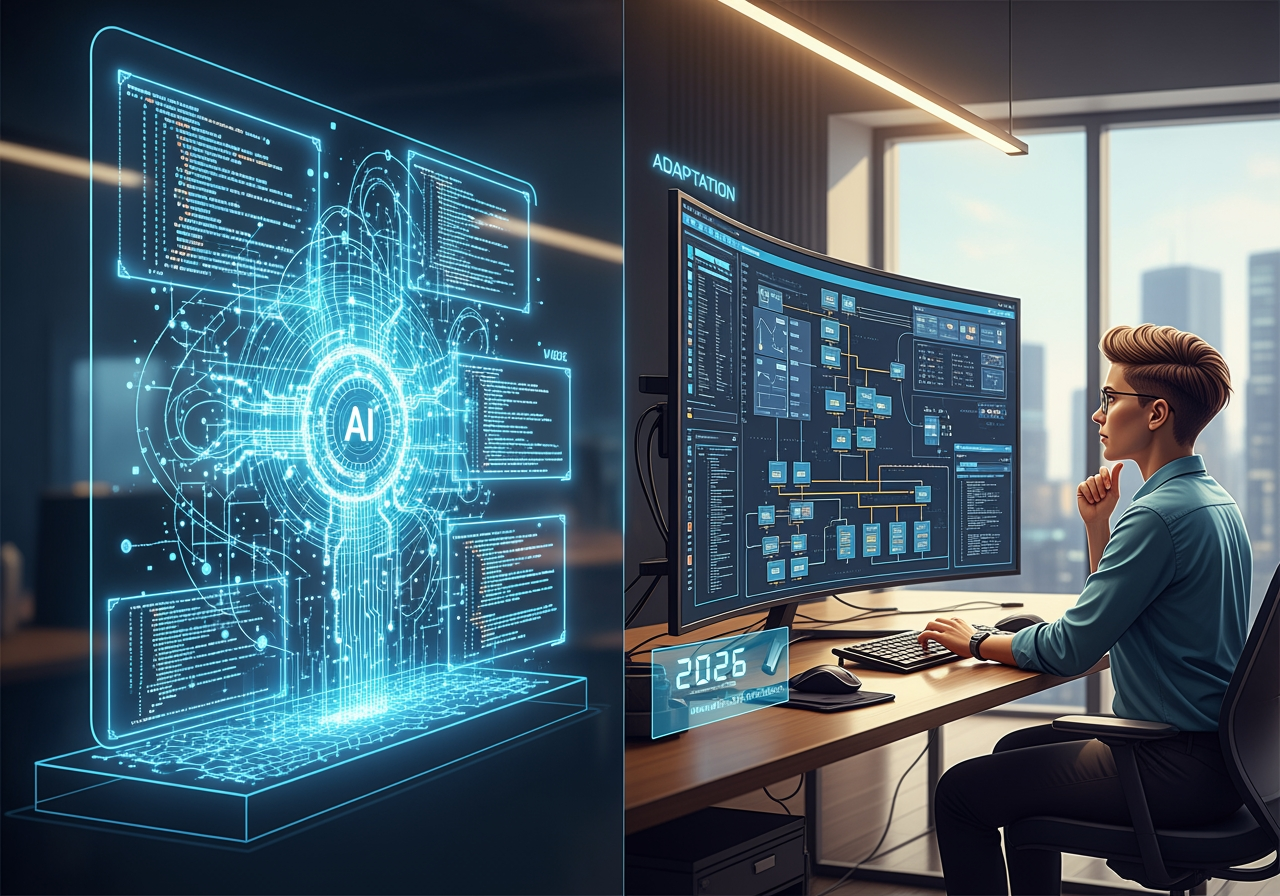
Artificial Intelligence is rapidly transforming software development, and by 2026, its impact on jobs is impossible to ignore. AI-powered coding tools, autonomous development agents, and low-code platforms are reshaping how software is built. While this evolution increases efficiency and speed, it also raises a serious concern: job displacement in the software industry.
The question is no longer if AI will change developer jobs, but how developers can adapt and survive in an AI-driven future.
How AI Is Changing Software Development in 2026
By 2026, AI has moved far beyond simple code suggestions. Modern AI systems can:
- Generate complete applications from specifications
- Debug, refactor, and optimize code automatically
- Write test cases and documentation
- Migrate legacy systems with minimal human input
- Deploy and monitor applications autonomously
AI development agents now handle tasks that once required entire teams. This has significantly reduced the demand for junior and repetitive coding roles.
Which Software Jobs Are Most at Risk?
Not all roles are affected equally. AI is most likely to reduce jobs that involve:
- Routine CRUD application development
- Basic frontend or backend implementation
- Manual testing and QA roles
- Entry-level programming tasks
- Maintenance-heavy legacy work
In many companies, one senior developer supported by AI tools can now do the work of multiple junior developers. This shift is a major reason why software hiring slowed down in 2026, despite increasing demand for technology.
Why AI Won’t Eliminate All Software Jobs
Despite these changes, AI cannot fully replace software engineers. AI lacks true understanding of:
- Business context and strategy
- Complex system architecture decisions
- Ethical and security trade-offs
- Creative problem-solving
- Accountability and ownership
Instead of replacing developers entirely, AI is reshaping job requirements. The demand is shifting from code writers to system thinkers.
How Developers Can Avoid Job Loss in 2026
The key to survival is adaptation, not resistance. Developers who evolve alongside AI will remain valuable.
1. Move Beyond Pure Coding
Coding alone is no longer enough. Developers must understand:
- System design and architecture
- Business logic and domain knowledge
- Scalability and performance trade-offs
AI can write code, but humans must decide what to build and why.
2. Learn to Work With AI, Not Against It
Developers should treat AI as a collaborator:
- Master AI coding assistants
- Learn prompt engineering for development tasks
- Review, validate, and improve AI-generated code
Those who know how to control AI tools will outperform those who ignore them.
3. Specialize in High-Impact Areas
Generalist roles are shrinking, while specialized roles are growing. High-demand skills in 2026 include:
- AI system integration
- Cybersecurity and privacy engineering
- Cloud-native architecture
- MLOps and AI governance
- DevOps and automation
Specialization makes developers harder to replace.
4. Focus on Problem-Solving and Communication
AI struggles with ambiguity. Developers who excel at:
- Understanding user needs
- Translating requirements into solutions
- Communicating with stakeholders
will remain essential in software teams.
5. Continuous Learning Is No Longer Optional
Technology cycles are shorter than ever. Developers must:
- Learn continuously
- Adapt to new frameworks and tools
- Stay updated on AI capabilities and limitations
In 2026, learning speed matters more than experience length.
The New Developer Role in 2026
The software developer of 2026 is:
- A designer of systems, not just code
- A decision-maker, not a task executor
- A supervisor of AI, not a competitor
Those who embrace this role will not only survive but thrive.
Conclusion
AI in software development is undeniably reducing certain job roles in 2026, especially repetitive and entry-level positions. However, it is also creating new opportunities for developers who are willing to evolve.
The future belongs to developers who:
- Think strategically
- Collaborate with AI
- Continuously upskill
AI won’t take your job — but a developer who knows how to use AI might.