
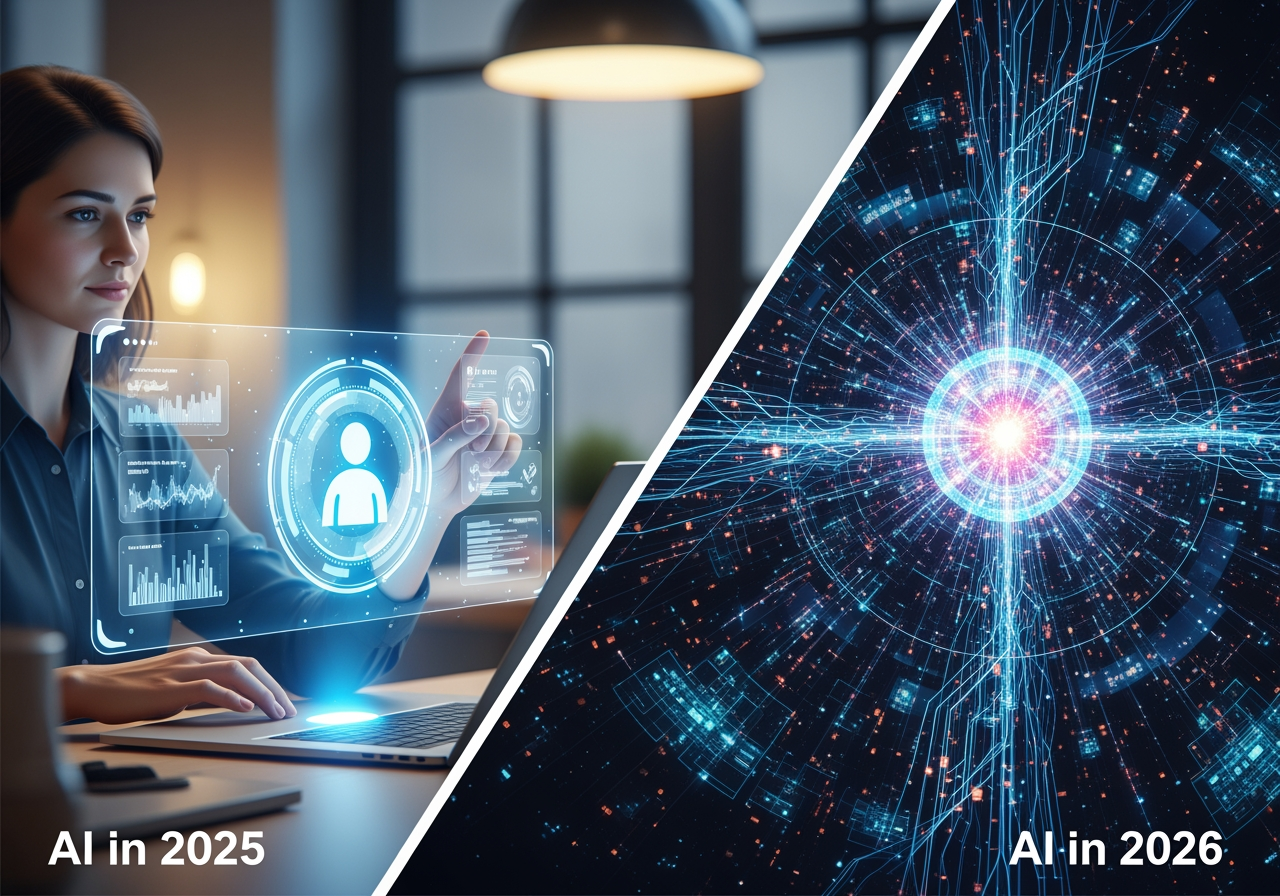
Artificial Intelligence has evolved rapidly over the last decade, but the transition from 2025 to 2026 marks one of the most significant shifts in AI history. While 2025 focused on expansion, experimentation, and integration, 2026 became the year of maturity, autonomy, and responsibility. Comparing AI news across these two years clearly shows how the technology moved from promise to practical dominance.
AI in 2025: The Year of Expansion and Experimentation
In 2025, AI adoption accelerated across industries, but most systems still relied heavily on human guidance. AI tools were widely used for productivity, content generation, customer support, and analytics. Large language models became more capable, multimodal AI gained attention, and generative AI entered mainstream business workflows.
Key AI news trends in 2025 included:
- Rapid growth of generative AI tools for text, images, and video
- AI copilots embedded into software platforms
- Increased investment in AI startups and infrastructure
- Early discussions around AI regulation and ethics
Despite these advances, AI in 2025 remained largely reactive. Systems responded to prompts but rarely initiated actions on their own. Concerns around hallucinations, bias, data privacy, and model reliability were frequent headlines. AI was powerful—but not fully trusted.
AI in 2026: The Rise of Autonomous Intelligence
AI news in 2026 reflects a turning point. Artificial intelligence became proactive, autonomous, and operational at scale. Instead of acting as tools, AI systems evolved into agents capable of planning, decision-making, and execution with minimal supervision.
Major developments in 2026 include:
- Autonomous AI agents managing workflows and operations
- Enterprise-grade AI with built-in compliance and explainability
- Stronger global AI governance frameworks
- AI systems collaborating with each other across platforms
Unlike in 2025, AI in 2026 began taking responsibility for outcomes, not just outputs. Businesses trusted AI to manage supply chains, analyse risks, and optimise strategies in real time.
Multimodal AI: From Feature to Foundation
In 2025, multimodal AI—capable of processing text, images, and audio—was still emerging. By 2026, it had become the standard. AI systems now seamlessly understand and generate across multiple data types, enabling advanced applications such as real-time diagnostics, immersive virtual environments, and intelligent surveillance systems.
This shift significantly improved context awareness, making AI more accurate and reliable.
Regulation and Ethics: Talk vs Action
AI ethics dominated conversations in 2025, but enforcement was limited. In 2026, regulation turned from discussion into implementation. Governments and international bodies introduced mandatory policies covering:
- AI transparency and disclosure
- Bias testing and fairness reporting
- Data usage accountability
- Human oversight requirements
AI news in 2026 frequently highlights compliance milestones rather than ethical warnings, signalling a more controlled and trustworthy AI ecosystem.
AI and the Workforce: Assistance vs Collaboration
In 2025, AI mainly assisted workers by automating repetitive tasks. In 2026, AI became a collaborator. Employees now work alongside AI agents that analyse data, suggest strategies, and execute tasks independently.
New job roles emerged, including:
- AI Operations Manager
- AI Ethics Officer
- Model Governance Specialist
Rather than replacing jobs, AI reshaped workflows and increased the demand for human judgement and creativity.
Infrastructure and Performance Improvements
AI systems in 2026 are faster, more energy-efficient, and better optimised than in 2025. Advances in hardware, edge AI, and model compression reduced costs and latency, enabling AI deployment even in resource-constrained environments.
This made AI more accessible, scalable, and sustainable.
Conclusion: A Defining Shift
The difference between AI news in 2025 and 2026 is not incremental—it is transformational.
2025 was about proving AI’s potential. 2026 is about trusting AI with responsibility.
As artificial intelligence continues to evolve, the focus has shifted from innovation alone to governance, autonomy, and long-term impact. The journey from 2025 to 2026 shows that AI is no longer just shaping the future—it is actively running parts of the present.