
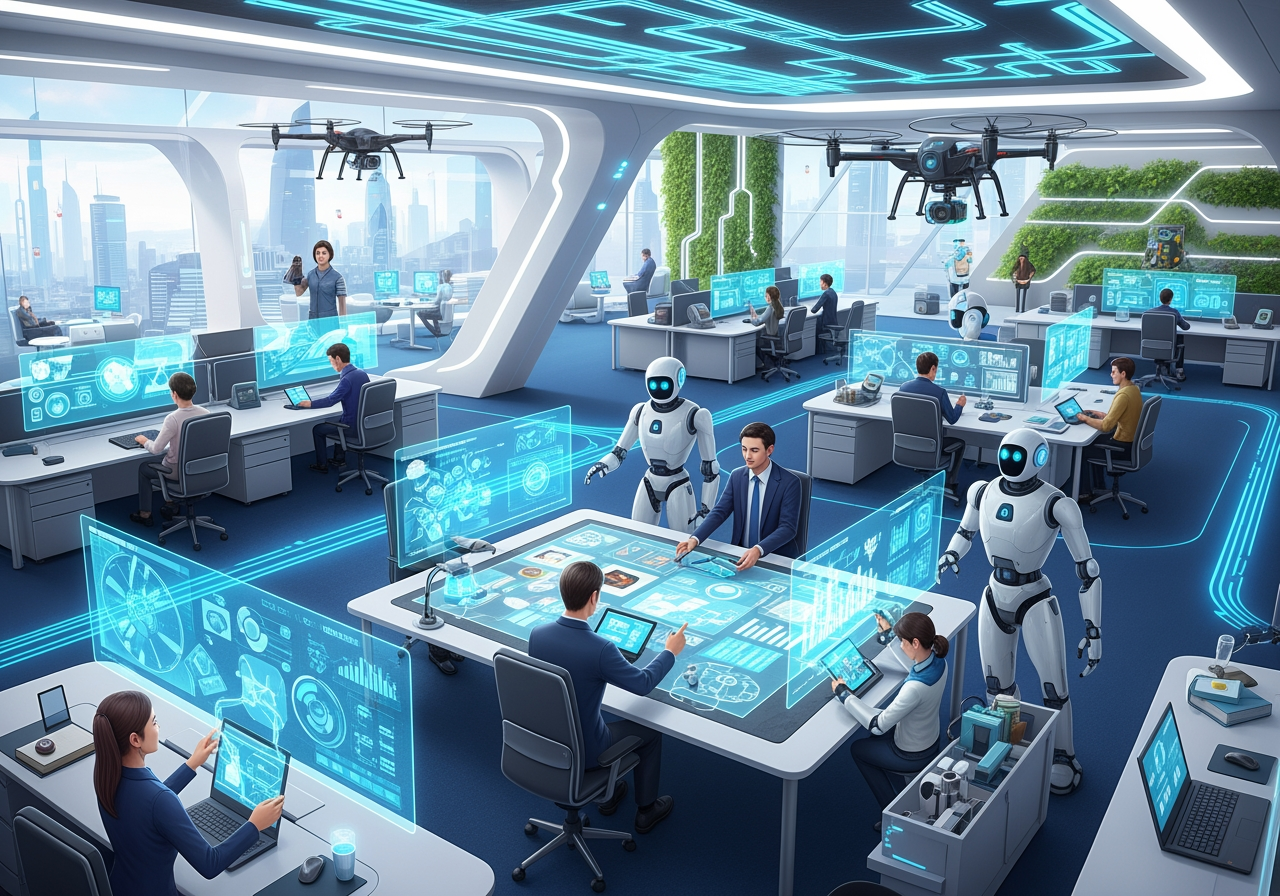
Artificial intelligence is transforming the global job market at an unprecedented pace. While automation has always influenced employment, AI introduces a deeper shift—one that affects not only manual and repetitive roles but also knowledge-based and creative professions. As AI adoption accelerates across industries, the conversation around jobs is moving from whether AI will change work to how humans can adapt and thrive alongside it.
How AI Is Changing the Nature of Work
AI excels at processing large amounts of data, identifying patterns, and executing tasks with speed and accuracy. As a result, many routine and predictable tasks are being automated. However, instead of eliminating work altogether, AI is redefining job roles.
Work is shifting from task execution to:
- Decision-making
- Oversight and supervision
- Strategy and creativity
- Human interaction and judgment
This transformation is affecting nearly every industry.
Jobs Most Vulnerable to AI Automation
AI is particularly effective at replacing jobs that involve repetitive tasks, standardized processes, and data-heavy workflows. Roles at higher risk include:
- Data entry and administrative support
- Basic customer service and call center roles
- Routine accounting and bookkeeping
- Manual quality checks in manufacturing
In these areas, AI systems can operate continuously, reduce errors, and lower costs.
Jobs That Will Evolve, Not Disappear
Many jobs will not vanish but will change significantly. For example:
- Software developers now collaborate with AI coding assistants
- Marketers use AI for analytics, content drafts, and personalization
- Financial analysts rely on AI for forecasting and risk analysis
These roles require human judgment, context, and ethical decision-making, which AI cannot fully replicate.
New Jobs Created by AI
AI is also creating entirely new career paths. Emerging roles include:
- AI trainers and model supervisors
- Prompt engineers and AI interaction designers
- AI ethics and compliance officers
- Data scientists and AI system auditors
These jobs focus on managing, improving, and governing AI systems.
Skills That Will Matter Most in the AI Era
As AI takes over technical execution, human skills become more valuable. Key future-proof skills include:
- Critical thinking and problem-solving
- Emotional intelligence and communication
- Creativity and innovation
- Adaptability and continuous learning
Workers who combine technical understanding with human skills will have the greatest advantage.
Impact on Different Industries
Healthcare
AI assists doctors with diagnosis and patient monitoring, but human care, empathy, and responsibility remain essential.
Education
AI personalizes learning, while teachers focus on mentoring and guidance.
Finance
AI automates analysis, while humans oversee strategy, compliance, and ethical risk.
Manufacturing
AI-driven automation improves efficiency, while humans manage systems and innovation.
Will AI Cause Mass Unemployment?
AI may displace certain jobs, especially at entry and routine levels. However, history shows that technological revolutions create new forms of employment. The challenge lies in managing the transition.
Governments, companies, and individuals must invest in:
- Reskilling and upskilling programs
- Lifelong learning initiatives
- Fair labor and transition policies
Job loss is a risk—but so is ignoring change.
How Workers Can Stay Relevant
To remain employable in an AI-driven world:
- Learn basic AI literacy
- Embrace AI as a productivity tool
- Focus on roles requiring judgment and creativity
- Continuously update skills
- Develop cross-disciplinary expertise
Adaptability is the most important career skill of the future.
Role of Employers and Governments
Organizations must:
- Use AI responsibly
- Support workforce transitions
- Invest in employee training
Governments play a critical role in:
- Updating education systems
- Supporting displaced workers
- Regulating AI use ethically
Collaboration between public and private sectors is essential.
Human-AI Collaboration: The Real Opportunity
The future of work is not humans vs AI—it is humans with AI. AI handles speed, scale, and data. Humans provide creativity, empathy, ethics, and purpose.
Together, they can unlock productivity and innovation beyond what either could achieve alone.
Conclusion
AI is transforming jobs, not eliminating work itself. While some roles will decline, many will evolve, and new ones will emerge. The key to success lies in adaptation, learning, and collaboration.
The future of work belongs to those who understand AI—not as a threat, but as a tool that amplifies human potential.