Generative Artificial Intelligence (GenAI) has moved beyond experimentation into real-world impact. From text and images to code, music, and video, GenAI is redefining how content, products, and ideas are created. As the technology matures, its future trends point toward deeper integration, greater responsibility, and stronger human collaboration.
The next phase of GenAI is not just about creation—it is about intelligent co-creation.
1. GenAI Will Become a Daily Work Companion
In the near future, GenAI will be embedded into everyday tools. Instead of standalone platforms, GenAI will function as a built-in assistant across:
- Email and communication tools
- Design and editing software
- Coding and development environments
- Business productivity platforms
GenAI will handle drafts, suggestions, and repetitive tasks, allowing humans to focus on strategy, creativity, and decision-making.
2. Rise of Multimodal GenAI Systems
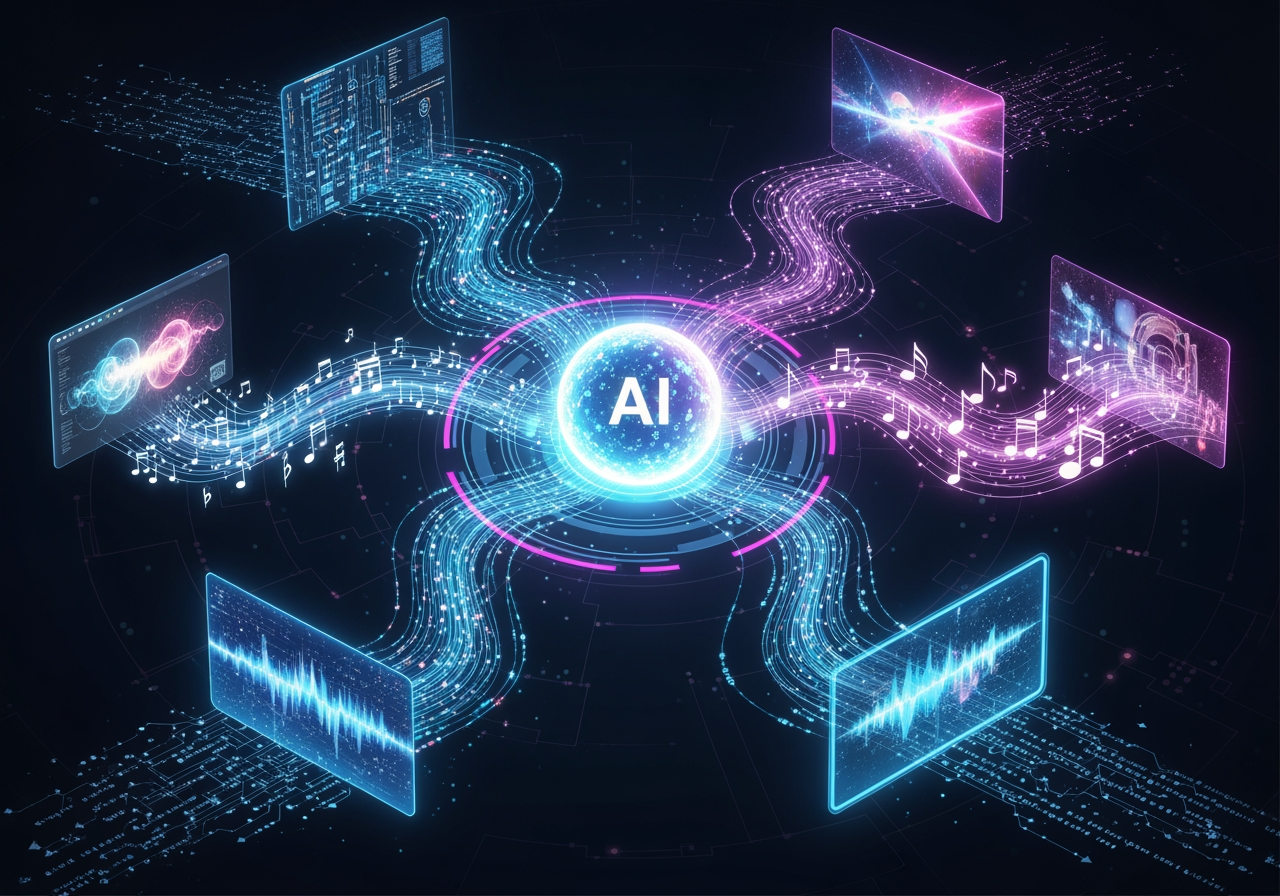
Future GenAI systems will be multimodal, meaning they can understand and generate text, images, audio, video, and code simultaneously.
For example:
- A single prompt could generate a marketing campaign with visuals, scripts, and copy
- Educational content could combine explanations, diagrams, and interactive elements
- Product designs could be created from text descriptions
This convergence will significantly speed up creative and technical workflows.
3. Personalization at Scale
GenAI will enable deep personalization across industries:
- Personalized education content
- Custom healthcare guidance
- Tailored marketing and customer experiences
Instead of generic outputs, GenAI systems will adapt to individual preferences, learning styles, and goals—making interactions more meaningful and effective.
4. GenAI in Software Development
Software development is one of the fastest-growing areas for GenAI adoption. Future trends include:
- AI-assisted coding and debugging
- Automatic documentation generation
- Code optimization and testing
- Low-code and no-code platforms powered by GenAI
Developers will shift from writing every line of code to designing systems and supervising AI-generated outputs.
5. Growth of Responsible and Regulated GenAI
As GenAI becomes more powerful, regulation and ethical oversight will increase. Future GenAI systems will emphasize:
- Transparency in AI-generated content
- Bias reduction
- Data privacy protection
- Clear labeling of AI-generated media
Responsible GenAI will be essential for maintaining trust and social acceptance.
6. GenAI in Education and Learning
Education will see major benefits from GenAI:
- Personalized tutoring
- Adaptive learning paths
- Instant feedback and assessment
- Creative learning materials
Teachers will use GenAI as a support tool rather than a replacement, enhancing the learning experience while maintaining human guidance.
7. Enterprise Adoption and Industry-Specific Models
Future GenAI will move toward domain-specific models trained for industries such as:
- Healthcare
- Finance
- Legal services
- Manufacturing
These specialized models will deliver higher accuracy, compliance, and relevance compared to general-purpose AI.
8. Creative Collaboration Between Humans and AI
GenAI will increasingly act as a creative collaborator. Artists, writers, designers, and musicians will use GenAI to:
- Explore ideas quickly
- Experiment with styles
- Overcome creative blocks
Human creativity will remain central, with AI expanding possibilities rather than replacing expression.
9. GenAI and Knowledge Work Transformation
Knowledge-based jobs will evolve as GenAI automates research, summarization, and analysis. Professionals will spend more time on:
- Critical thinking
- Interpretation
- Strategic planning
GenAI will become a productivity multiplier rather than a job replacement tool.
10. Democratization of Creation
One of the most powerful trends is accessibility. GenAI lowers barriers by allowing people with minimal technical skills to:
- Create content
- Build applications
- Launch businesses
- Learn complex subjects
This democratisation could unlock innovation at an unprecedented scale.
Challenges Ahead
Despite its promise, GenAI faces challenges:
- Misinformation risks
- Over-reliance on AI-generated content
- Intellectual property concerns
- Energy and infrastructure demands
Addressing these challenges will determine the long-term success of GenAI.
Conclusion
The future of Generative AI is defined by collaboration, responsibility, and creativity. GenAI will become an invisible yet essential partner in work, education, and innovation.
Rather than replacing human intelligence, GenAI will amplify human potential, enabling people to create, learn, and solve problems faster than ever before.
Those who learn to work with GenAI today will shape the digital world of tomorrow.