
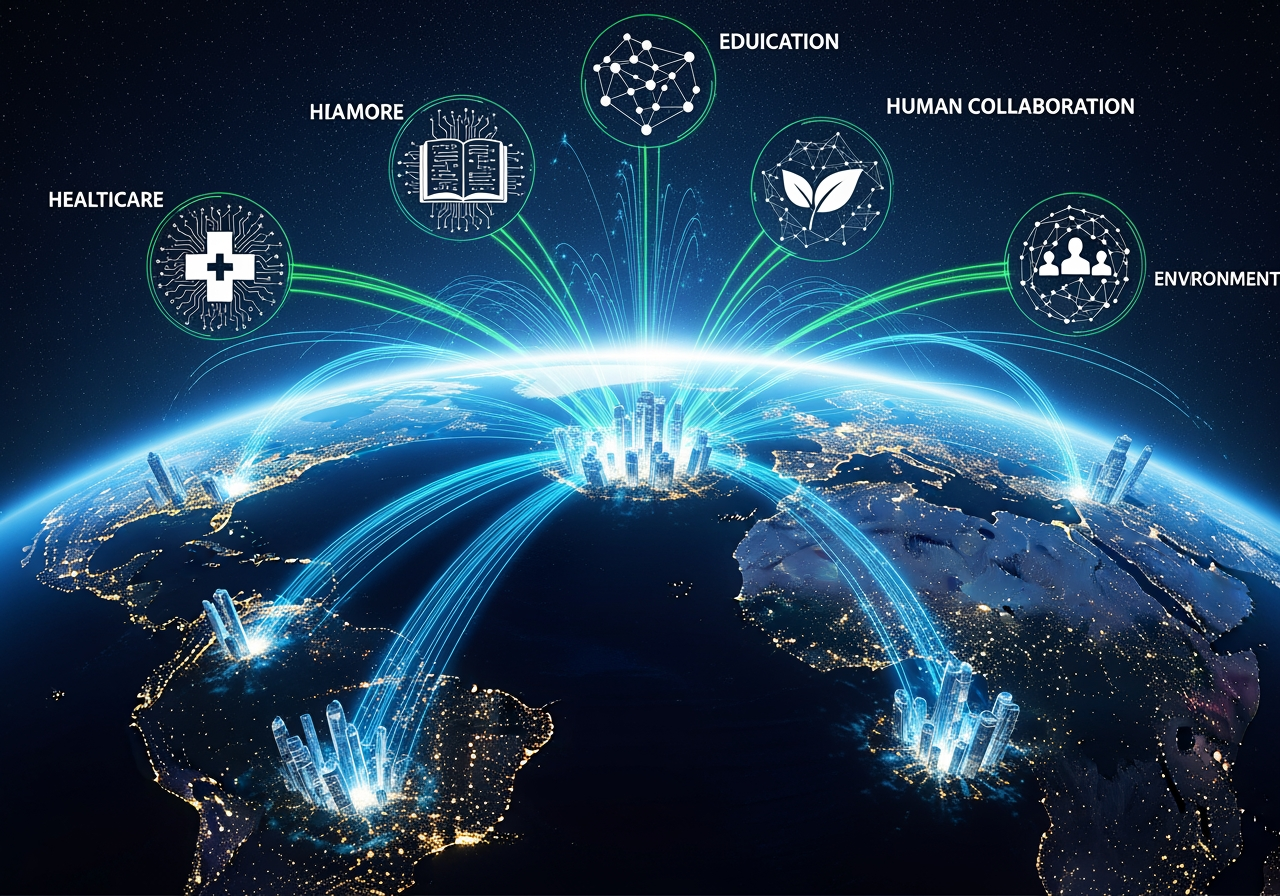
Artificial intelligence is no longer a distant concept limited to science fiction or research labs. It has become a core force reshaping industries, societies, and daily life. As AI systems grow more advanced, their influence is expanding beyond automation into decision-making, creativity, and human collaboration.
The future powered by AI is not about machines replacing humans—it is about transforming how the world works.
AI as the Foundation of Future Economies
In the coming years, AI will become the backbone of global economies. Businesses are already using AI to optimize operations, reduce costs, and increase efficiency. In the future, AI will:
- Automate complex workflows
- Predict market trends
- Optimize supply chains in real time
- Enable smarter financial planning
Countries investing heavily in AI infrastructure are positioning themselves as future economic leaders. AI-driven productivity will play a major role in economic growth and competitiveness.
Transformation of the Workplace
The workplace is undergoing a major shift due to AI. Routine and repetitive jobs are increasingly automated, while new roles are emerging. AI will:
- Reduce manual data processing
- Assist decision-making with predictive analytics
- Enhance collaboration between teams
Future jobs will focus more on creativity, strategic thinking, emotional intelligence, and system oversight. Workers who adapt and reskill will find greater opportunities in this new environment.
AI in Education and Skill Development
Education systems worldwide are being reshaped by AI. Traditional one-size-fits-all learning models are giving way to personalized education. AI-powered learning platforms can:
- Adapt lessons to individual learning speeds
- Identify strengths and weaknesses
- Provide instant feedback
- Support teachers with planning and assessments
This creates a more inclusive and effective learning experience, preparing students for an AI-driven future.
Healthcare Revolution Through AI
Healthcare is one of the most promising areas for AI impact. AI will support doctors and medical professionals by:
- Detecting diseases at early stages
- Analyzing medical images accurately
- Predicting patient risks
- Supporting personalized treatment plans
In remote and underserved regions, AI-powered telemedicine can provide access to quality healthcare, reducing global health inequalities.
Smarter Cities and Infrastructure
AI will play a critical role in building smart cities. Urban planning and infrastructure management will rely on AI systems to:
- Reduce traffic congestion
- Optimize energy usage
- Improve public safety
- Enhance waste management
These intelligent systems will make cities more sustainable, efficient, and livable for growing populations.
AI and Environmental Sustainability
Climate change and environmental challenges require data-driven solutions. AI can help by:
- Monitoring climate patterns
- Optimizing renewable energy sources
- Predicting natural disasters
- Improving resource management
By analyzing vast amounts of environmental data, AI supports faster and more effective responses to global challenges.
AI in Creativity and Culture
AI is becoming a partner in creativity rather than a replacement. Artists, writers, musicians, and designers use AI to:
- Explore new ideas
- Speed up creative workflows
- Enhance quality and experimentation
AI tools expand creative possibilities while leaving final expression and emotional depth in human hands.
Ethical and Social Considerations
As AI becomes more powerful, ethical considerations grow more important. Key concerns include:
- Data privacy
- Bias in AI systems
- Transparency and accountability
- Responsible decision-making
Governments, organizations, and developers must work together to ensure AI is developed and deployed ethically, with human values at its core.
Human-AI Collaboration: The Real Future
The true future of AI lies in collaboration. AI excels at processing data, identifying patterns, and scaling operations, while humans excel at empathy, judgment, creativity, and moral reasoning.
When humans and AI work together, outcomes improve across industries—from healthcare and education to business and governance.
Preparing for an AI-Driven World
To thrive in the AI-powered future, individuals and organizations must:
- Embrace continuous learning
- Develop digital and AI literacy
- Focus on adaptability and problem-solving
- Understand AI as a tool, not a threat
Preparation today determines success tomorrow.
Conclusion
Artificial Intelligence is reshaping the world at every level. Its influence will continue to grow, touching economies, education, healthcare, cities, and culture. While challenges exist, the potential benefits of AI far outweigh the risks when managed responsibly.
The future powered by AI is not about replacing humanity—it is about amplifying human potential.
Those who understand, adapt, and collaborate with AI will shape the world of tomorrow.