
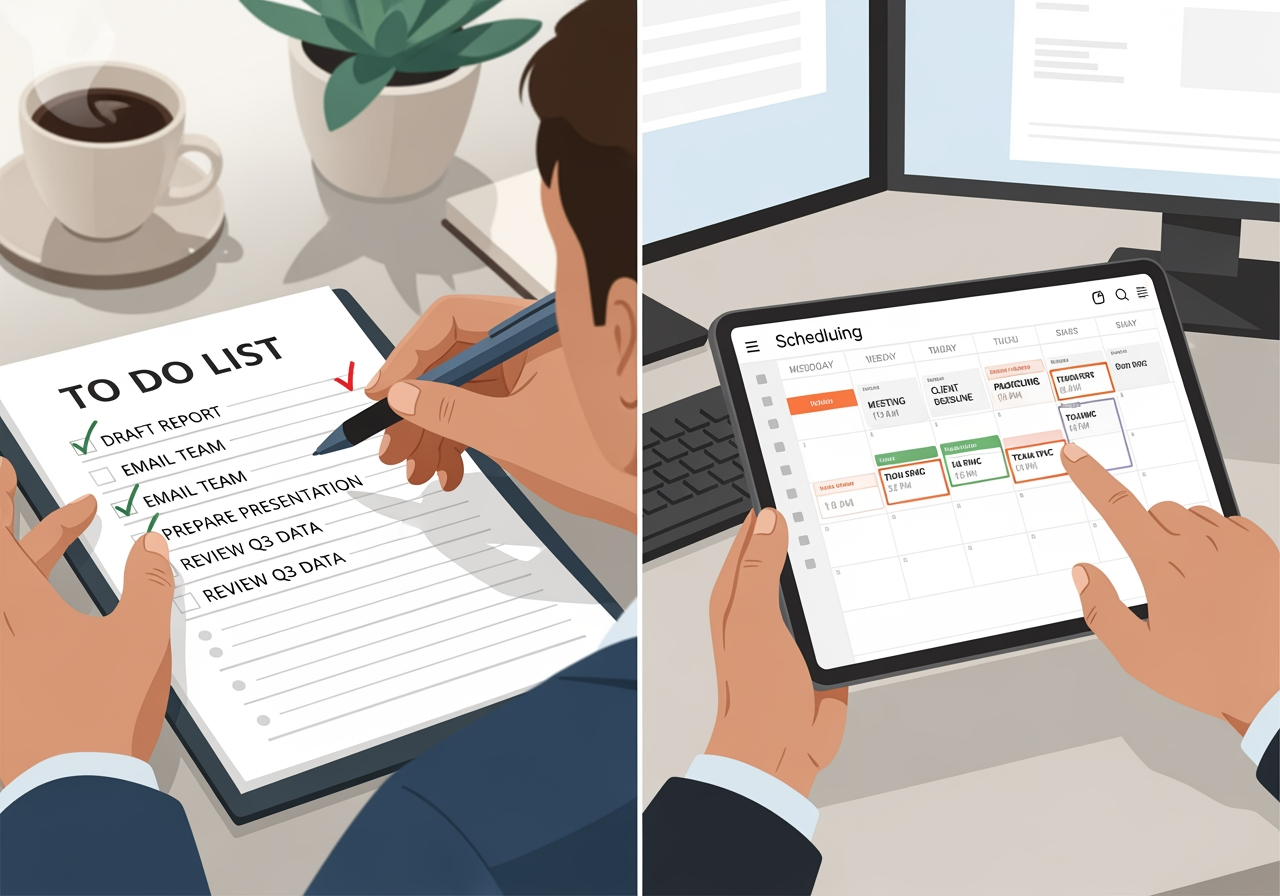
Productivity is a goal that almost everyone strives for—students, professionals, and entrepreneurs alike. Two of the most popular tools for organizing work are to-do lists and schedules. While they may seem similar, each serves a unique purpose, and understanding the difference can dramatically improve efficiency and focus.
This guide explores the pros, cons, and best practices for both, helping you choose the right approach—or combine them effectively.
What Is a To-Do List?
A to-do list is a simple list of tasks you need to complete. It doesn’t specify when you should do them—just that they need to be done.
Example of a to-do list:
- Finish monthly report
- Call the client
- Buy groceries
- Prepare presentation slides
Advantages of To-Do Lists
- Simplicity – Easy to create and maintain.
- Flexibility – You can rearrange tasks or skip items as needed.
- Motivation – Checking off items provides a sense of achievement.
- Captures everything – Great for brainstorming tasks without worrying about timing.
Disadvantages of To-Do Lists
- Can become overwhelming if too long
- No guidance on when to do each task
- Easy to procrastinate on big or difficult tasks
What Is a Schedule?
A schedule assigns tasks to specific times or blocks during the day. It’s more structured than a to-do list and often includes start and end times for each activity.
Example of a schedule:
- 8:00 AM – 9:00 AM: Morning exercise
- 9:00 AM – 11:00 AM: Work on report
- 11:00 AM – 11:30 AM: Break
- 11:30 AM – 1:00 PM: Call clients
Advantages of a Schedule
- Time management – Helps allocate time for each task.
- Focus – Reduces multitasking and distractions.
- Predictability – You know exactly what to do and when.
- Accountability – Easier to measure progress against deadlines.
Disadvantages of a Schedule
- Less flexible—changes can disrupt the day
- Can feel restrictive for creative or unpredictable work
- Over-scheduling can cause stress
To-Do List vs Schedule: Key Differences
| Feature | To-Do List | Schedule |
|---|---|---|
| Time Specific | No | Yes |
| Flexibility | High | Low to medium |
| Focus on Task | Task completion | Task + time management |
| Best For | Quick task tracking, brainstorming | Structured productivity, deadlines |
| Motivation | Checking off items | Meeting deadlines and time goals |
When to Use a To-Do List
- When your tasks are short-term or simple
- For brainstorming and capturing ideas
- When flexibility is needed to prioritize urgent tasks
- For personal tasks, errands, or small work items
To-do lists are excellent for daily task capture but may fail when you have a busy day with multiple time-bound commitments.
When to Use a Schedule
- For tasks that have strict deadlines
- When you need to focus on deep work or study
- For managing multiple responsibilities across time blocks
- When coordinating with teams or external commitments
Schedules are better for structured productivity and minimizing procrastination.
Combining To-Do Lists and Schedules
The most effective approach is often a hybrid system:
- Start with a to-do list – Write down everything you need to do.
- Prioritize tasks – Identify urgent, important, and low-priority items.
- Assign high-priority tasks to a schedule – Allocate time blocks to focus on key activities.
- Use the to-do list for flexibility – Keep smaller or low-priority tasks there to tackle when possible.
This way, you get the clarity of a schedule and the flexibility of a to-do list.
Tips to Boost Productivity
- Set realistic goals – Don’t overfill your schedule or to-do list.
- Time-block deep work – Dedicate uninterrupted periods for complex tasks.
- Review and adjust daily – Reflect on what worked and what didn’t.
- Use digital tools – Apps like Todoist, Notion, Google Calendar, and Trello help combine both methods.
- Break tasks into smaller steps – Smaller tasks are easier to schedule and complete.
Conclusion
Neither a to-do list nor a schedule is inherently “better.” The choice depends on your tasks, deadlines, and work style. Beginners may start with a to-do list to capture everything, then gradually move toward scheduling important tasks. Experienced professionals often use both together—to-do lists for flexibility and schedules for structure.
By understanding the strengths and weaknesses of each, you can design a system that maximizes productivity, reduces stress, and ensures you get important things done—without feeling overwhelmed.